

How Stress Hijacks Your Gut — and Why That's Costing You Sleep and Focus
The Symptoms You Keep Dismissing Are Trying to Tell You Something
Shweta Singh has been in high-impact corporate roles for 13 years while raising her 3-year-old and in she observed a trend in herself and people around her. The body was sending signals - signals that they would dismiss as unrelated and just temporary:
- IBS flare-ups
- Unexplained body pain
- Fragmented sleep
- Persistent irritability
- Brain fog severe enough to hollow out cognitive function by midday
Every symptom had a perceivable fix. None of them worked
"We would plan vacations to fix this but what will unlock a change for them will be to understand stress and solve the root cause sustainably not makeshift external solves such as vacations"
— Shweta Singh, Co-Founder, EquaRoots
Urban professionals tend to think of these symptoms as brief hiccups—symptoms of a hectic season that will ease up once life slows down. They'll think of how they can fix this with a weekend getaway or with better sleep, . But this kind of troubleshooting analytics misses the larger picture. That poor sleep, brain fog, digestive issues, or mood problems are not distinct symptoms—they're signs that a singular system (and the gut) is in distress.
Understanding this connection is changing the perspective of professional when they approach their symptoms - not as separate complaints to contain, but as signs of a deeper imbalance that requires sustainable intervention.
What Is the Gut-Brain Axis — and Why Should You Care?
Both your brain and your gut are constantly chatting with each other, and usually, neither one is quiet for very long. The brain sends tons of signals down to the gut, telling it to digest, secrete, and use the immune system. At the same time, the gut sends messages upwards that impact cognition, mood, and resilience to stress. This circle of communication between the gut and the brain is known as the gut-brain axis, and it operates through four major pathways: neural (primarily the vagus nerve, which acts as a communication road between the gut and brain), immune (inflammation travels in both directions that impact both brain and gut), hormonal (control of the gut's stress-response system and communication back to the brain), and metabolic (brain chemistry that's changed by microbial byproducts). Your gut microbiota functions as the messenger for this system, producing, amplifying, and modulating the signals that reach the brain. When the microbiome, gut, and brain are all healthy, signals move back and forth smoothly. When dysbiosis occurs—meaning the good bacteria dies off while the bad bacteria flourishes—both the gut and brain send distress signals, which can affect cognitive clarity to sleep timing and everything in between. This isn't a gray area theory about how stress affects our brains. This is the neurobiology of stress, a real system that affects how our body functions and how well we recover, think, and sleep. Prioritizing understanding of the gut-brain axis helps us understand at first glance how our symptoms can be fragmented, but are likely outputs of a single system that becomes fragile when our sleep does.

How Your Gut and Brain Communicate Constantly
How a Disrupted Gut Steals Your Sleep
Our gut and brain communicate with each other, and they they don't just regulate digestion — they regulate sleep. When there are sleep problems, they are rarely rooted in the brain. Instead, they originate in the gut. The microbes in our gut produce the neurotransmitters that our brain uses to regulate sleep-wake cycles: GABA, serotonin, and dopamine. Serotonin is also a precursor to melatonin, the hormone which induces sleep. When microbial diversity collapses in dysbiosis, production of these neurotransmitters also plummets — leaving our brain deprived of the raw material it needs for quality, well-regulated sleep.
Dysbiosis fractures sleep through a combination of channels:
- Circadian rhythm disruption — Disrupting tryptophan metabolism and vagal nerve signaling, dysbiosis sabotages the gut's ability to communicate timing info to the brain
- HPA axis dysregulation — The hypothalamic-pituitary-adrenal axis controls the body's secretion of stress hormones. If dysbiotic, it can't modulate HPA signaling. Chronic activation of this system keeps cortisol levels high and prevents sleep
- Neuroinflammation — Dysbiosis can also cause immune dysregulation that, through the bloodstream and vagus nerve, travels to the brain and perpetuates wakefulness.
This sequence is a vicious cycle that goes like this: chronic stress weakens the gut barrier function, dysbiosis worsens, and the microbiota produces metabolites that inhibit neurotransmitter synthesis. The brain—starved of serotonin and GABA—locks into wakefulness. The sleep deprivation stresses the body even more and intensifies dysbiosis even further. The loop continues with no way out without treatment.
The reversal itself is straightforward: when the microbial balance is restored, neurotransmitter production revives and the HPA axis is recalibrated. This leads to better sleep. A number of randomized controlled trials have shown measurable improvements in sleep quality from probiotic interventions. Beyond populations and types of interventions, we see the same pattern being true: restoring microbiomes is a key lever on the path back to sleep.
If dysbiosis has such a wild influence on sleep regulation, what collateral cognitive damage does it do to the brain's higher functions?
Why Brain Fog Is Often a Gut Fire That Reached Your Head
The process of sleep disruption occurs under the radar in the microbiota. Brain fog, by contrast, carries measurable cognitive consequences, including declining working memory, concentration, and processing speed. But it still stems from the same cause — a dysbiotic gut that crossed its own boundaries.
When the intestinal lining isnt acting as a good barrier, bacterial endotoxins - most notably lipopolysaccharide (LPS) enter the bloodstream. In this case, LPS is like sparks that set off inflammation throughout the body, and ultimately, the brain. Dysbiosis allows pathogen-associated molecular patterns into the bloodstream, which subsequently induces immune cell activation and pro-inflammatory pathways, thus disrupting the blood-brain barrier.
Here is how neurobiological damage is triggered:
- Neuroinflammation. Microglia (the "brain's immune cells") become pro-inflammatory, flooding the brain with inflammatory cytokines that create the mental fog associated with difficulty concentrating, recalling, or processing information.
- Tryptophan pathway disruption. Dysbiosis alters tryptophan metabolism toward kynurenine production instead of serotonin. Kynurenine can cross the blood-brain barrier and may further impair cognitive function.
- Suppressed BDNF. Dysbiosis decreases hippocampal brain-derived neurotrophic factor – a molecule associated with cognitive sharpness and critical for memory formation.
Brain fog may be a gut symptom, but it is almost never recognized as one. The symptom is purely cognitive, which prevents clinicians from looking at the microbiome for answers. A person with poor focus will associate it with aging, stress, or overwork—not a bacterial imbalance in the gut. This disconnect means that, in many cases, the cognitive problem is not treated at the source.
As important as it is to recognize interrupted sleep as an intervention point in the body, the inflammation that spreads from a leaky gut to the brain also demands direct recognition as a distinct intervention point.

From Leaky Gut to Brain Fog
What Breaks the Gut in the First Place?
It's not a singular event that collapses the gut. Instead, it's an erosion of multiple simultaneous pressures coming from all angles. The inflammation that muddies our thinking doesn't happen in our brains - it starts here - in the microbial environment professionals allow to go bad.
|
Problem |
Mechanism |
Effect |
|---|---|---|
|
Chronic stress |
Cortisol spikes alter microbiota composition directly |
Beneficial bacteria decline; dysbiosis takes hold |
|
Ultra-processed diet |
Refined sugars and low fiber starve good bacteria |
Dysbiosis worsens; pathogenic species flourish |
|
Dysbiosis |
Imbalance of good vs. bad bacteria escalates permeability |
Leaky gut allows endotoxins into bloodstream |
|
IBS, SIBO, Candida, food sensitivities |
Chronic inflammation from these conditions persists |
Systemic and neuroinflammation amplifies |
Stress can cause surges in the cortisol levels which can affect your microbiome in a matter of hours. An ultra-processed diet that's high in refined sugars and low in fiber can starve beneficial bacteria and encourage pathogenic bacteria growth. This overgrowth can speed up dysbiosis and gut permeability, allowing bacterial endotoxins to leak into the bloodstream. If you have food sensitivities, Candida overgrowth, IBS, or SIBO, this inflammatory effect can be magnified at each step.
The problem with how urban professionals approach health: each of these problems is treated as a separate failure. Stress not only clouds your thinking -- it also throws your gut out of balance. A poor diet doesn't just add empty calories -- it contributes to a state of dysbiosis. Each compound problem feeds the other. Treating them all as a one-off symptom of a separate failure means that the cycle of stress, gut, and brain imbalances will continue. To reverse it, you need to address the system as a whole and start by understanding what interventions can actually reset it.
Can Microbiome Health and Psychobiotics Reverse This Damage?
When it comes to chronic stress, processed foods, and dysbiosis, the state of damage is not irreversible. Probiotic strains called psychobiotics don't treat digestion in isolation, but target the gut-brain axis to improve mood, cognition, and quality of sleep.
Research illustrates that targeted bacterial strains measurably improve sleep and cognitive outcomes:
|
Stra |
Conditions Studied |
Study Duration |
Results |
|---|---|---|---|
|
Bifidobacterium breve A1 |
Mild cognitive impairment |
16 weeks |
|
|
Bifidobacterium longum 1714 |
Poor sleep quality |
4 weeks |
Reduced daytime dysfunction and better sleep quality |
|
Prebiotics + probiotics + synbiotics |
Sleep, Depression, Anxiety |
Variable |
Synergistic effect that improves mood and sleep |
Here lies the critical distinction: a vacation offers short term relief - an outside fix that lasts until Monday morning. Fixing the gut problem at the source is different. Probiotics rebalance microbial diversity, reduce intestinal permeability, and lower systemic inflammation that feeds the stress-gut-brain loop.
It's a very direct mechanism. When the microbes are restored in balance, neuroinflammation is reduced and vagal signaling recalibrated — which is exactly why downstream symptoms (such as persistent anxiety, brain fog, poor sleep) will start to resolve as a consequence of, rather than coincidence with, the mechanism.
This is the power of targeted interventions like EquaRoots. You can't leverage one strain to undo years of dysbiosis in isolation, but you can combine prebiotic, probiotic, and synbiotic support to deliberately rebuild an ecosystem.
Knowing which strains serve what purpose—and why—turns the selection of supplements into a more informed choice instead of a guessing game. What's next is applying this science.
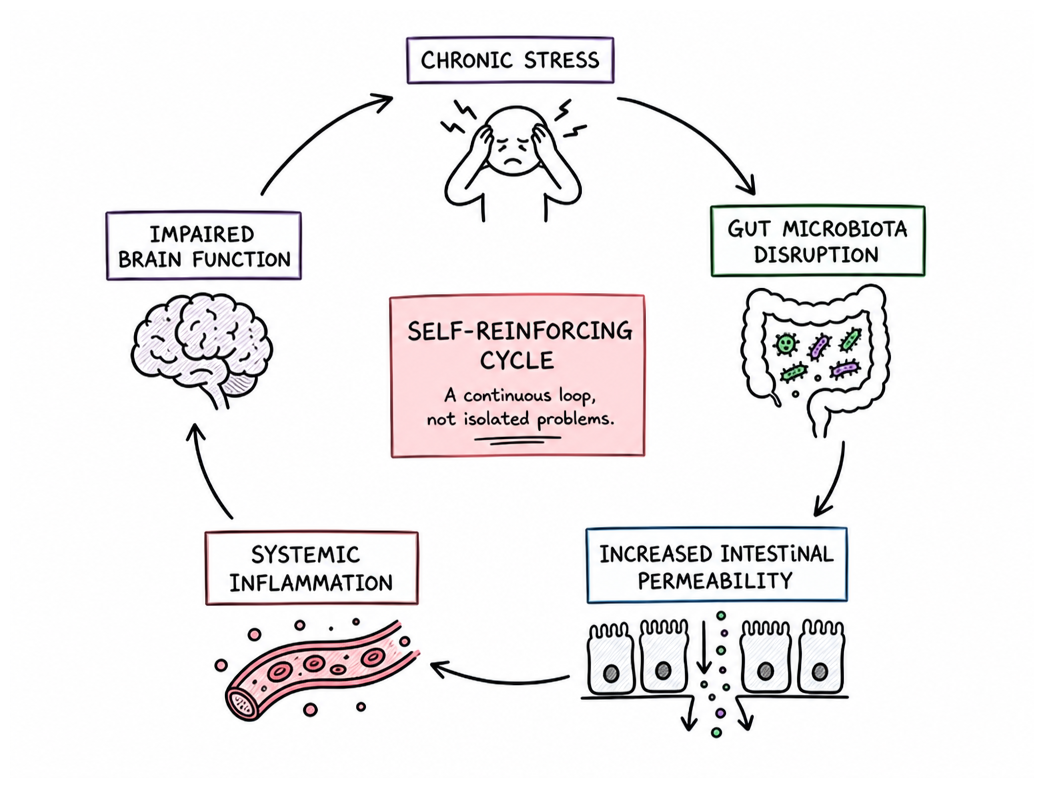
The Self-Perpetuating Stress-Gut-Brain Cycle
Practical Steps to Break the Stress-Gut-Brain Cycle
Knowledge about the gut-brain axis demands actionable change. Here are some actionable steps to treat the gut and brain and rebuild critical microbial diversity to break the cycle that robs of clarity and sleep.
- Eat diverse, fiber-rich foods.
- Get a daily dose of fermented foods.
- Limit ultra-processed foods and refined sugars.
- Develop consistent movement and sleep routines. G
- Get professional recommendations for prebiotic and probiotic supplements - one customized for the issue at hand not just the one with cocktail of strains
While these approaches may seem simple, regular implementation can shift your microbiome within a matter of weeks.
The Root Cause Has Been There All Along
Shweta's journey — from experiencing unexplained symptoms to co-founding EquaRoots — is one many urban professionals that don't even realize they are living through it. Her fog, sleeplessness, and physical unease all were directly linked to an overlooked system: the gut.
The gut-brain axis goes beyond just being abstract neuroscience; it is the tangible mechanism that explains why chronic stress tanks cognitive function, destroys sleep, and triggers cascading physical symptoms.
Symptom management is a holding pattern. Microbiome restoration seeks to truly address what the symptoms are protecting against—which is the dysregulated bacterial ecosystem that allowed symptoms like brain fog, insomnia, and chronic unease to begin. Moving away from isolated complaints and moving toward root dysfunction isn't a wellness trend, It's a sustainable alternative to ongoing rounds of cognitive band aids.
At EquaRoots, we're rooted in the pioneering science of gut-brain axis and targeted mental health support, putting microbiome health at the forefront of our approach. Gut health is the first variable to fix - not the last.